I'm nine months into recovering from low energy availability, which means refueling my body after years of underfueling. Weight gain can be a normal part of that recovery, and it can also be really hard. My energy, sleep, and focus are better than they've been in years, and I'm also the heaviest I've ever been. Below I share where I am, why this can happen, what I'm doing right now, and the tools I use to coach myself through the hard days.
In this post:
Some links in this post are referral links, so I may earn a small commission if you buy something. I only recommend products I personally use and/or that are backed by extensive research and experts I trust. Thank you for supporting my small business!
Medical disclaimer: This content is for informational purposes only. Nothing in this post is medical advice. Always talk with your own healthcare provider before making changes to your diet, exercise, or health routine.
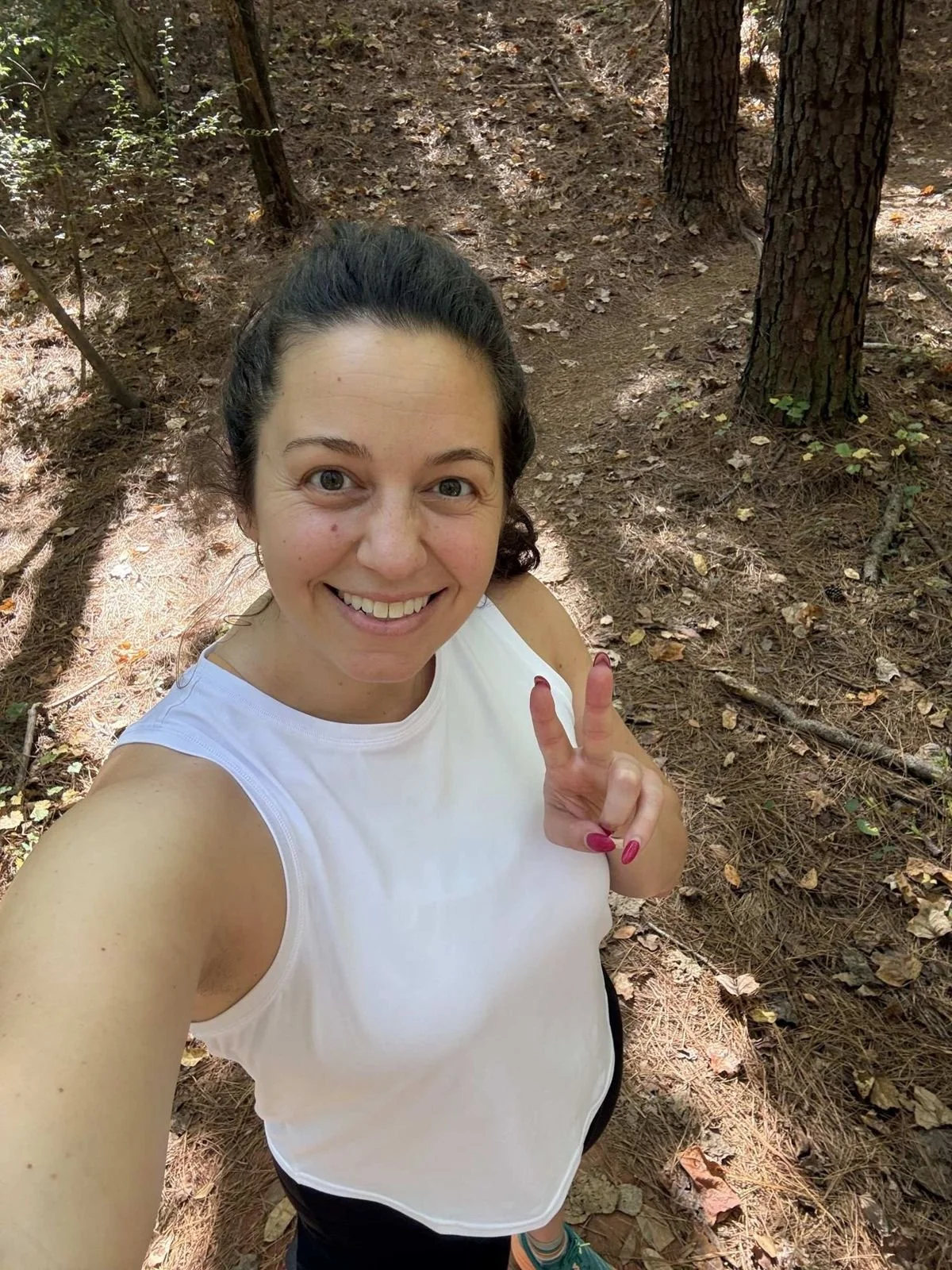
Where I Am Nine Months Into Refueling
In February 2026, I started refueling my body on purpose after realizing I'd been underfueling for years, probably since college. (I share the full story of how I found out in How I Fixed My Sleep and Low Energy.)
Nine months in, so many things have improved! This is the first year of my life I've eaten as much as I've wanted without feeling guilty, and what a gift that is! My sleep has improved, my energy is better, and my brain feels sharp again. I'm remembering things, I can find the words I want to say, and I feel more articulate. My blood work has massively improved, and my thyroid, insulin, and glucose markers all look good.
While all of that is amazing, my weight and body fat have gone up and I'm the heaviest I've ever been. Even though I know it’s necessary, this part of the process in particular has been much more challenging. Most of my clothes don't fit, which has been another frustration because I also don't want to buy a whole new wardrobe when I know this is temporary.
Two things can be true at once: I feel so much better, and I’m still frustrated. The more I come to peace with that, the better I feel! I use the tools below every day to help with my mental perspective and processing.
Why Weight Gain Can Happen During LEA Recovery
Low energy availability (LEA) happens when you don't eat enough to cover what your body needs for everyday life plus your training. When it's prolonged or severe, it can lead to Relative Energy Deficiency in Sport (REDs, sometimes written RED-S), which affects everything from your hormones and metabolism to your mood, recovery, and performance (2023 IOC consensus statement).
When your body has been underfueled for a long time, it goes into protection mode. Researchers studying athletes recovering from prolonged LEA note that the body's adaptations can prime it to store body fat once fuel comes back (Journal of the International Society of Sports Nutrition, 2025). Sports dietitian Renee McGregor also points out that REDs isn't always tied to weight loss, because the body adapts to protect itself during a big energy deficit (Fuel for Thought excerpt).
McGregor writes that some research suggests a minimum of 18 months for full recovery, depending on how long you were underfueled and on your own body. UPMC sports medicine says treatment can span months to years (UPMC).
So if you're gaining weight while you refuel, it doesn't mean you're doing something wrong. It can actually be a sign you're doing something right: your body finally has the fuel it needs to heal. To learn more about how recovery works, read Cleveland Clinic's overview of REDs.
When I started, I thought it would take about six months. I pictured my body fat peaking a few months in and then coming back down. That's not what's happening. I'm about halfway through an estimated 18-month timeline, and I'm learning to be patient with a timeline I can't control.
There's No Quick Fix
In 2020, during an energy psychology training, I began healing my body dysmorphia. (I wrote about it here.) I'm still healing more deeply and becoming healthier mentally, and this year has tested that work more than any other.
I love my body, and I'm so grateful for everything it's doing. The struggle is that I physically feel uncomfortable in it right now. It's not the number on the scale. It's carrying more body fat than I'm used to and not fitting into my clothes.
Some days I still catch myself asking, "How long am I supposed to be patient for?" When that question comes up, I come back to what I know: my energy, sleep, and blood work are proof my body is healing, even if the part I can see is taking longer than I want.
This process takes months to heal and progress is slow. There’s no “quick fix” for the body. I experienced a similar timeline when I healed my gut health. The only “solution” I’ve found is coming to peace with the unknown and trusting the process, which especially came to a head during a hike earlier this fall…
When I Stopped Trying to Force It
By August, my body was showing good signs of recovery, and my nutritionist approved more workouts and a very slight calorie reduction. My Hall of Fame induction was coming up in October, and I had a picture in my head of how I wanted my body to look by then. So I pushed. I walked more, hiked more, and stayed consistent, but the changes were slow.
In September, I went on my first hike in a while after taking some time off for a small injury, and I had a really good cry. I realized I'd been pushing hard for an outcome my body wasn't ready to give me yet. It wasn't going to look the way I wanted by the ceremony, and no amount of effort was going to change that. I was grieving the expectations I'd put on myself, on my body, and on my recovery.
So I stepped back into acceptance. Letting myself feel all of it brought me peace instead of the friction I'd been holding on to. While it was sad, it was also a relief. I shared more about that hike on YouTube.

What I'm Doing Right Now
Here's what my routine looks like today, for my body and my mind. I'm working with guidance, and this isn't a plan for you to copy, because every body and every recovery is different.
Taking care of my body
Eating enough, on purpose. Refueling meant intentionally increasing my calories. I track my calories to make sure I'm eating enough, but not obsessively and not every day. Since late August, I've been slowly bringing my calories down (with the approval of my nutritionist), and I'm still very much in a safe zone.
Prioritizing sleep. Sleep is where my body repairs and recovers, so it comes first.
Lifting 2 to 4 days a week, usually 3, depending on my schedule, plus mobility work.
At least 8,000 steps a day.
No HIIT for now. My body doesn't respond well to it at this stage, so I'm not forcing it.
Rhodiola Rosea for my mood. I take Momentous Rhodiola Rosea every day, and I share what the research says in my Rhodiola Rosea post.
Creatine for my mood and mental performance. I take Momentous Creatine, and I share the research behind it in my creatine post.
A sauna blanket once a week. I use the Lifepro RejuvaWrap Infrared Sauna Blanket.
A massage every 1 to 2 months. I love my intuitive massage therapist! She focuses on fascia and lymphatic massage, which have both been so important for my recovery.
Taking care of my mind
I've had real moments of doubt this year. What's gotten me through is coaching myself with the same tools I teach my clients and audiences.
When doubt hits, I breathe, and I say, "I trust this is happening for my best and highest good," and "I trust my path completely."
It doesn't take away from how hard it is. It lets me take a step back, so I don't have to know why it's happening or when it will change.
Breathing, always first. Three deep breaths, in through your nose and out through your mouth, is a real reset for your nervous system. I also love the silly ones I do with almost every group I work with: breathing out like you're blowing through a straw, a lip flutter, and a big, loud sigh. When you laugh, your nervous system relaxes, too. I walk you through these in my Breathing Techniques for Calm and Focus video.
A morning prayer for patience. "Please help me be patient today. Help me be patient when things don't go my way, or the way I think they should go."
Beliefs I say and feel every morning. I don't just say them, I feel them in my body. What does it look like to move through my day as someone who is resourced and whole?
I am resourced and whole.
I love who I am and who I'm becoming.
My peace and well-being are my highest priority.
Taking care of my health and well-being allows me to be more successful and financially abundant.
The last two work as a pair. When I first started healing my gut health issues, "My peace and well-being are my highest priority" was the only one I used, and my business slowed down. Adding the second belief reminded me I can take care of my body AND grow my business.
Rewriting old beliefs. If an old belief about your body keeps showing up, here's the 4-step process I teach:
(1) Notice it. You need awareness before you can change anything.
(2) Rewrite it. Make it first person, present tense, positive, fairly short, and meaningful to you.
(3) Feel it as done. This is the step most people skip. How do you move, talk, and feel when it's already true?
(4) Integrate it. Say it and feel it every day. A new belief needs repetition to stick.
Being proactive about stress. I don't overbook myself, I protect my calendar, and I use these tools every day, before stress has a chance to build.
Rest. I now know rest is part of my life, not something I have to earn. I used to think I had to be exhausted in order to rest. Rest isn't just sleep, either. For me, it's slow mornings, days off, and downtime from technology.
Play. Play is also an important piece of recovery. For me, that looks like:
Dance parties
Puzzles
Spending time in nature
Hanging out with friends
Sitting outside quietly
Social media boundaries. I take regular breaks from social media, and I curate my feed so it helps me instead of making me feel worse.
An emotional release exercise, when I need it. These days, that's usually about once a month. I recorded the exact exercise I use, and you can learn more about it here.
Key Experts I Follow
These are the three experts I trust to talk about nutrition, LEA, and REDs, and the accounts where they share it:
Dr. Stacy Sims (@drstacysims) researches women's physiology and training. Her newsletter on LEA and REDs is what first made me realize what was going on.
Melissa Lodge, PhD, RDN (@fed_collaborative) is a REDs researcher and sports dietitian focused on female athlete health and performance.
Sophie VanSurksum (@basalmethod) shares heavy lifting and holistic healing, with so many helpful insights.
The 30-Minute Emotional Release
This is the tool I use A LOT, and it's been instrumental in my healing since 2020.
When we push emotions down, they stay in the body, which is why that cry on my hike helped so much. The 30-Minute Emotional Release is a practice I've developed over the years. I've done it with more than 100 people, and because I saw such a need for it, I recorded it so you can do it on demand. You pick one emotion, find where your body has been holding it, and release it. It draws on ancient healing traditions and research from Dr. Peter Levine, Dr. Bruce Lipton, and Dr. Joe Dispenza.
During my recovery, I've used it to release frustration, resentment, and grief. It can be used on any emotion, whether it's related to LEA recovery or anything else. This process has helped me and my clients through so many different parts of life, and I consider it an essential tool.
It's $33, and you can watch it as many times as you need. Once you're more familiar with the practice, you can shorten it. Most times, I can do a release for myself in 5 to 10 minutes.
FAQ
These answers come from my own experience and aren't medical advice. Please work with your doctor or a registered dietitian who understands REDs.
Is it normal to gain weight during low energy availability recovery?
It can be, and it has been for me. Researchers note that prolonged LEA can prime the body to store fat once fuel comes back (Journal of the International Society of Sports Nutrition, 2025). Cleveland Clinic's overview of REDs is a great place to learn more, and your doctor can tell you what's normal for you.
Should I cut calories if I'm gaining weight during recovery?
Work with a doctor or registered dietitian who understands REDs first. Never cut calories on your own during recovery. I only started making a very slight reduction once my nutritionist approved it, and I'm still very much in a safe zone.
How long does LEA or REDs recovery take?
There's no set timeline. It depends on how long you were underfueled and on your body. UPMC says treatment can span months to years, and Renee McGregor writes that some research suggests at least 18 months for full recovery.
How do you handle clothes not fitting?
I found a few key pieces that work, bought a few new items, and I'm doing the best with what I have. I'm also more okay repeating outfits than I normally would be. Now that we're moving into winter, sweaters and leggings are my go-to! I've been loving Quince lately for affordable, comfortable staples, and my referral link gets you $20 off.
What do you do when you doubt the process?
I breathe first and let myself feel it. Then I say, "I trust this is happening for my best and highest good." When it feels heavy, I do the emotional release exercise. If food or your body ever feels all-consuming, please reach out to a professional. The National Alliance for Eating Disorders has a free helpline.
Still Trusting the Process
I don't have this figured out, and I'm not done. Some days are hard, and some days I feel at peace with exactly where I am. Either way, I'm going to keep breathing, keep fueling my body, and keep trusting my path.
If you're in the middle of this too, you're not alone.
If your energy has been low for a while, you can read about how I fixed my sleep and low energy.
And if you're ready to feel and perform better in all aspects of life, let's work together 1:1! My coaching is for mindset and overall performance strategy, not nutrition, so please work with a qualified health professional for that part.