Your Emotional Tank: What's Actually Draining Your Performance (And How to Fill Your Cup)
Most high performers are focused on the wrong problem.
They're adjusting their habits. Refining their strategy. Adding more discipline. Working harder, staying later, optimizing every hour of the day.
And yet — something still isn't clicking. The focus isn't there. The motivation is inconsistent. The results are plateauing. Or worse, they're hitting a wall they can't explain.
Here's what I know after 12+ years of coaching high performers: the problem usually isn't effort. It's their emotional tank.
You've probably heard the phrase "you can't pour from an empty cup." That's exactly what we're talking about — except most people nod at that idea and then immediately go back to pouring anyway, wondering why they feel depleted. The emotional tank is the framework that makes "fill your cup" actionable. It tells you what's draining it, what refills it, and what becomes possible when you stop running on fumes.
What Is the Emotional Tank?
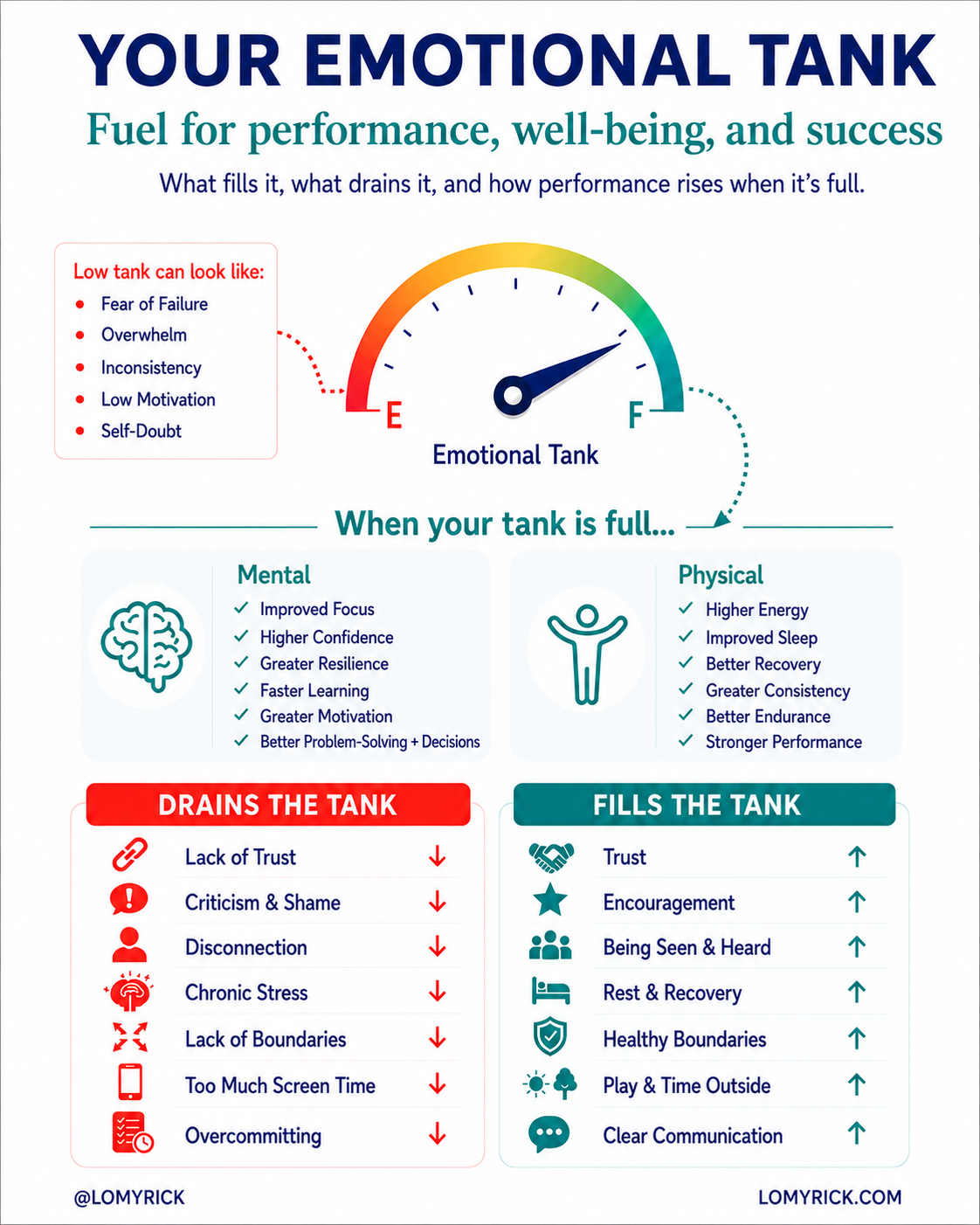
Your emotional tank is your internal capacity to perform, lead, recover, and show up as your best — and like any fuel source, it can be full, half-empty, or running on fumes.
Think of it like a fuel gauge that moves based on what's happening in your life, your relationships, your environment, and your body.
When it's full, you have capacity. You can think clearly, lead effectively, recover quickly, and access your best.
When it's running low, everything gets harder — not because you've lost your abilities, but because you don't have the fuel to access them.
Here's the key insight that changes everything: emotional capacity isn't soft. It's directly tied to your mental and physical performance.
Signs Your Emotional Tank Is Running Low
This is where most people miss it. A low emotional tank doesn't always look like sadness or burnout. In high performers, it often shows up as:
Fear of failure
Overwhelm
Inconsistency
Low motivation
Self-doubt
Sound familiar? These are often treated as character flaws or discipline problems. They're not.
They're signals — your system telling you the tank is running low.
When I work with someone who's inconsistent, overwhelmed, fearful, or underperforming, the first place I look isn't their strategy. It's what's draining their emotional capacity.
What Drains the Tank
Emotional capacity gets depleted by specific conditions — many of which are so normalized in high-performance environments that people don't even recognize them as drains:
Lack of trust — in a leader, a team, a relationship, or yourself. When trust is missing, you're operating in a chronic state of protection instead of performance.
Criticism and shame — especially repeated criticism after mistakes. This doesn't just sting in the moment. It reduces your willingness to take risks, ask for help, and learn fast.
Disconnection — from people, purpose, or your own sense of self. Humans are wired for connection. Without it, resilience erodes.
Chronic stress — not the productive kind that sharpens focus, but the relentless, low-grade kind that wears down your system over time.
Lack of boundaries — without them, energy leaks in every direction. Overgiving, resentment, and reactive performance follow.
Overcommitting — too many open loops, too little recovery, too much pressure with nowhere to release it.
Too much screen time — overstimulation, comparison, and nervous system load that quietly depletes you without feeling like "a big deal."
If any of these are present consistently, the tank will drain — regardless of how talented, disciplined, or motivated you are.
How to Fill Your Emotional Tank
Here's the good news — your cup can be refilled. Emotional capacity restores, and the path back is more practical than most people expect. You don't need a month off or a major life overhaul. You just need to start consistently giving your system more of what actually restores it.
Some examples:
Connect with a friend — real connection, not a scroll session
Prioritize sleep — recovery is not optional; it's fuel
Get a massage or bodywork session — direct nervous system regulation
Hit the sauna — proven stress reduction and recovery benefits
Spend time outside — nature resets the system in ways screens never will
Take a 48-hour pause from social media — reduce the stimulation load
Have an honest conversation — unspoken tension drains the tank quietly; naming it refills it
Make time for play — not productivity, not optimization. Play.
Notice something about this list: none of it is about doing more. It's about giving your system what it needs so that everything you already do lands differently.
That's the shift: you don't need to push harder. You need to take care of yourself and fill your own cup.
What Changes When the Tank Is Full
When your tank is full — when your cup is actually full — everything shifts. Mentally and physically.
Mental performance:
Improved focus and concentration
Higher confidence
Greater resilience under pressure
Faster learning
Better decisions and problem-solving
Physical performance:
Higher energy levels
Improved sleep quality
Better recovery
Greater consistency
Stronger endurance and output
This isn't a coincidence. When you feel better, you perform better. And when the tank is depleted, even the most talented, disciplined people struggle to access what they're truly capable of.
This Applies to You and to Every Person You Lead
If you're a leader, coach, or anyone responsible for a team's performance — this matters beyond your own tank.
The people you lead are operating with emotional tanks too. When they seem disengaged, inconsistent, or stuck, the first question worth asking isn't "what's wrong with their work?" It's "what's draining their capacity — and am I helping build the conditions that refill it?"
High-performing teams aren't built on pressure. They're built on trust, encouragement, clear communication, and an environment where people feel seen and supported.
The conditions that fill tanks don't just benefit individuals. They shape culture, retention, resilience, and results.
If you lead people, reflect on these questions:
Have I checked in on my team's well-being lately? Do I do it regularly or sporadically?
Am I depleting their tanks — or filling them?
According to Gallup, 80% of employees who receive meaningful feedback at least once a week are fully engaged — and that weekly check-ins deliver four times the engagement lift of any office attendance policy. It's one of the simplest things a leader can do to fill their team's tanks.
Where to Start
If you're reading this and recognizing yourself — or someone you lead — in any of it, here's the place to start: stop looking at the output and start addressing the root cause.
Look at what's draining your capacity — then start deliberately adding more of what fills it back up.
Taking care of yourself isn't the opposite of high performance. It IS high performance.
Ready to Go Deeper?
Feeling the weight of a depleted tank — the stress, the overwhelm, the belief systems that quietly hold you back?
Next Level Self — On-Demand Experience → This self-paced experience is designed to help you do exactly what this post talks about — shed the stress and overwhelm that's draining your tank, shift the limiting beliefs that keep you stuck, and step into your next level. You can start the moment you're ready, at your own pace.
Book a Performance Breakthrough Session → Get immediate relief and clarity in 90 minutes. In this 1:1 session, we identify exactly what's draining your tank and build a clear, actionable plan to restore your capacity and performance — fast.
Frequently Asked Questions About the Emotional Tank
What is an emotional tank? Your emotional tank is your internal capacity to perform, lead, and show up at your best. Think of it like a fuel gauge — or the cup in "you can't pour from an empty cup." It rises and falls based on the conditions in your life, relationships, and environment. When it's full, performance improves. When it's depleted, even the most disciplined people struggle.
How is filling your emotional tank different from filling your cup? It's not — they're the same thing. "You can't pour from an empty cup" is the idea most people already know. The emotional tank is the framework that makes it actionable: it gives you a way to identify what's draining your cup, what refills it, and what actually changes when it's full. Same concept, more to work with.
What are the signs of a low emotional tank? Common signs include fear of failure, overwhelm, inconsistency, low motivation, and self-doubt. These are often mistaken for character flaws or discipline problems — but they're actually signals of a depleted system.
How do you fill your emotional tank? By intentionally building conditions that restore your capacity: sleep, connection, honest communication, time outside, rest, play, and reducing chronic stressors like overcommitting and too much screen time.
Can emotional capacity affect physical performance? Yes. A full emotional tank is associated with higher energy, better sleep, faster recovery, greater consistency, and stronger physical output. Emotional and physical performance are deeply connected.
Is this just mindset work? No — and that's the point. Emotional capacity operates at the nervous system level. It's not just about thinking differently. It's about the actual conditions, relationships, and habits that restore your system so you can access your best.
Lo Myrick is a Peak Performance & Leadership Keynote Speaker, Coach, and Consultant. She works with high performers, executives, athletes, and teams to identify the invisible bottlenecks limiting their performance — and address the underlying cause, fast. Learn more →